
Find customers’ value
Three things get said to every agency that brings AI into client work. AI kills the billable hour. You should bill for tokens, the way the model companies do. Outcome pricing is where everyone ends up.
I disagree with all three as rules.
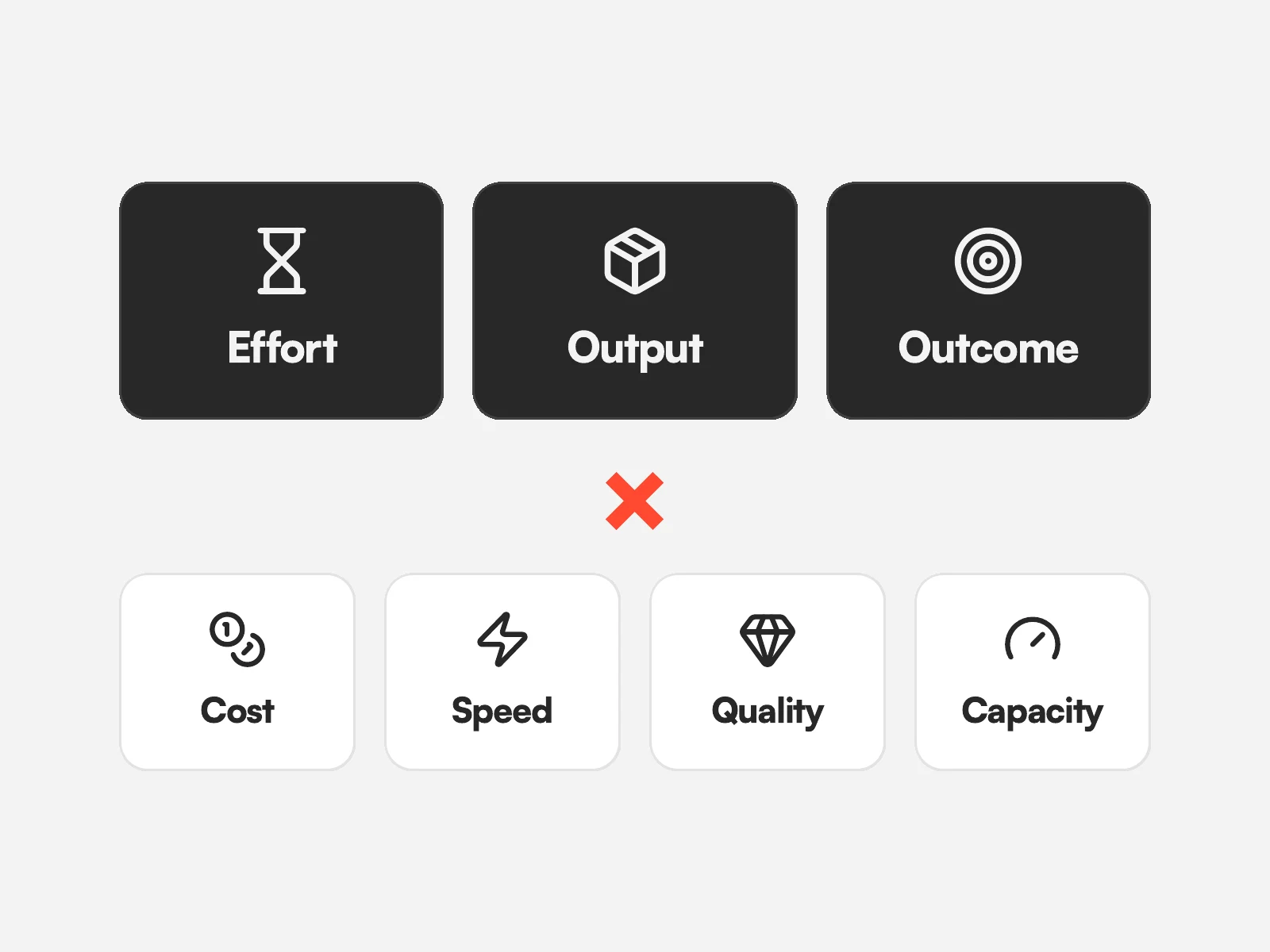
From your client’s side, the way you sell agency work does not change with AI. They are still buying one of three things: your effort, your output, or an outcome. Which one you sell depends on what you offer, and on how much of the result is in your hands.
Effort
Effort is what goes in: time, tokens, materials. The market’s name for it is time and materials.
Time and tokens are the same kind of thing. Both measure how much went into the work. More effort may produce more output, but it may be the wrong output. Whether it is the right one depends on the expertise of whoever is driving.
So effort is the right unit when the task and the output still have to be discovered. Research, software development, anything being done for the first time. A software agency bills a month of time to work out what to build, because nobody can name the deliverable yet.
The client carries the risk. They pay whether or not the outputs turn out right.
Output
Output is finished work: projects and deliverables.
A creative agency delivers a graphic. It is complete and it is useful. It is also not in an ad yet, so it has not produced a single impression.
That is what makes it an output. Getting from there to the result takes the client’s own time, resources or capabilities, which the agency does not control.
The risk is shared. The agency owns the road from effort to output. The client owns the road from output to outcome.
Outcome
An outcome is the result itself.
A lead generation agency books first sales meetings from its own outreach. It runs the outreach, it knows how the market responds, and it can predict the result from its own work alone. That is an outcome it can sell.
Closed sales are not. Closing needs the client to execute, and once the result depends on someone else, outcome pricing breaks down.
Here the agency carries the risk: it is paid only when the result happens. In return, an outcome is the most valuable thing an agency can sell. For a full service, it is the best offer.
Uplevel your offer
Each step is an upgrade: from effort to output, and from output to outcomes.
Standardize your offer to move from effort to output. Once you know what the work produces, you can name it and price it.
Own more of the work to drive results to move from output to outcome. The more of the road to the result that runs through your agency, the more of the result you can sell.
Find your market’s lever
The unit is what you sell. The pricing model is how you set the number.
Your pricing model depends on what your client wants control over. There are four levers: cost, speed, quality and capacity. Each model hands the client one of them.
Cost-plus: cost
Cost-plus is usually the wrong model for an agency. The expertise and the setup are expensive, and the inference is cheap, so what the work costs to run tells a client almost nothing about what it is worth.
A doctor trains for twenty years and answers your question in five minutes. The answer is valuable because of the twenty years.
Cost-plus fits once the work has become standard and commoditized. When every supplier’s version is alike, cost is the lever left to pull. A translation agency charging for each page at its cost plus a fixed margin is in that position.
Competitor-based: speed
Pricing against competitors is a good place to start when the market is new and does not yet understand the value. You anchor against what others charge, then explain the difference.
It is not the same as pricing AI at a discount to people, which rarely makes sense.
I ran a software agency this way. Clients arrived with quotes from our competitors for their whole vision. We quoted for the fifth of it that mattered most, at the same quality, delivered fast. Over the long run the full build would have cost about the same. But they had what they needed quickly, and they reshaped their business and their rollout around it. The prioritisation and the speed were what they were paying for.
AI makes agencies faster still. That is more value to the client, which is why an AI-native firm should often cost more, not less.
Value-based: quality
Value-based pricing asks one question: from the client’s side, what is this worth?
Sometimes the answer traces directly to an outcome. Sometimes it does not. Value and outcome are different ideas, and an output can be priced on value as well. Project pricing lives here too.
A conversion agency that prices a checkout redesign on the revenue it should add is pricing on value.
Bidding: capacity
Bidding is the new one.
As agency work becomes fully automated, demand can outrun capacity, because there is only so much compute to go round. When that happens, clients bid for a share of it, the way advertisers bid for placements. An AI agent that needs ad creative within the hour pays the going rate for a slot.
Agencies will be serving AI agents on demand. This is the model for that.
Find your model
There is no model that fits every agency. The right one depends on your industry, on what your clients will accept, and on how much risk you are willing to carry.
What we see working, and what we encourage, is changing your pricing when AI teammates join the work. That often means raising it, for different value. The real work is going back to the client and reimagining the service from scratch, with them in the room.
Over time we expect agencies to move toward value-based pricing, and to explore bidding as their demand grows.
None of this is about commoditizing what you do. It is about showing your value and anchoring your price to it.
Where Ergoly sits
Think of Ergoly as a generalist staffing company. A staffing firm places capable people with you and bills for their time. It does not decide what they work on, or what you charge your clients for it.
Ergoly works the same way with AI teammates. You can ask one for anything, so we price the most general thing, effort, and leave the rest to you. You know your market. You define the right outputs for the outcomes you sell, and you choose the unit and the model that fit.
Three layers, each built on the one beneath: effort at the bottom, output above it, outcome on top. Ergoly’s AI teammates are one piece of the effort layer.
Outcome
The result you sell.
Output
The right outputs, defined by you.
Effort
What goes in.
 ErgolyAI teammates
Last updated November 22, 2026