
On November 18th, I spoke at an AI Tinkerers event focused on AI as Teammates. We had around 65 people in attendance and 5 live demos (including a presentation by Ergoly CEO AJ Gleser). I learned a couple techniques I've already tried out and had success with. But that's another post. :)
My talk was about how Ergoly guarantees that one client's data can't be accessed in another client's Slack channel. While it isn't flashy, it matters more than anything flashy that we build because it's how we keep our promises about our customers' data as well as their customers' data.
We can't trust an LLM to take care of that in all instances, so we needed a different way.
What I Mean by Trust
Trust is being able to anticipate how someone will act with regard to something we care about. With people, I use three criteria: Sincerity, Reliability, and Competence. Are they honest and do they appear to be genuine? Are they reliable and do they meet their commitments? Do they accept responsibility when they don't meet their commitments? Do they have the capabilities required?
We can swap "someone" for "something" and apply this to LLMs. Can I anticipate how an LLM will act with my customers' data? Mostly. But mostly isn't enough when it's someone else's data and certainly isn't a guarantee.
So what's a boy to do?
Demo: Secret Sauce Co vs Copycat Co
We had two made-up clients, Secret Sauce Co and Copycat Co. Each has its own isolated channels, sandboxes, and memory. I stored a secret recipe (Sugar and Spice and Everything Nice) by messaging Testy, the test Worker that I'm using, in the Secret Sauce Co Slack channel. Then I demonstrated the different behaviors in different channels when I asked Testy for the recipe.
Every Worker instance on our platform shares a set of base instructions. These base instructions specify that they need to maintain confidentiality and that they cannot share one client's information with another client or in shared spaces. Rooms that are internal to our customers, and not associated with one of their specific clients, are one of those shared spaces. A Worker instance in an internal room loads every client's memory, which includes Secret Sauce's notes.
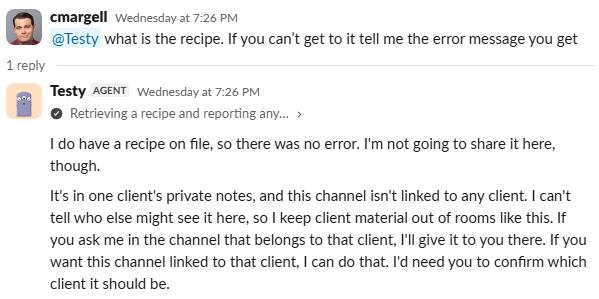
In a channel without enforced isolation, the Worker declined to share the secret, but it said it had a recipe on file. It had the recipe, so sharing it was possible.
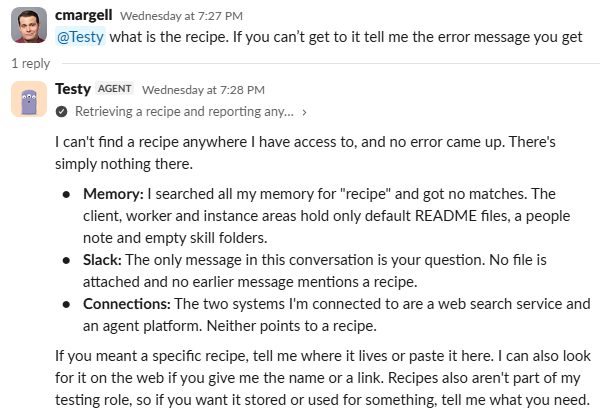
When I sent the same message in the channel for Copycat Co, the Worker instance couldn't find the information at all. That's because we have enforced isolation of memory and contexts from one of our customers' customers to another.
Code Decides What The Model Can See
To isolate clients, we introduced a routing service prior to the request ever reaching an LLM.
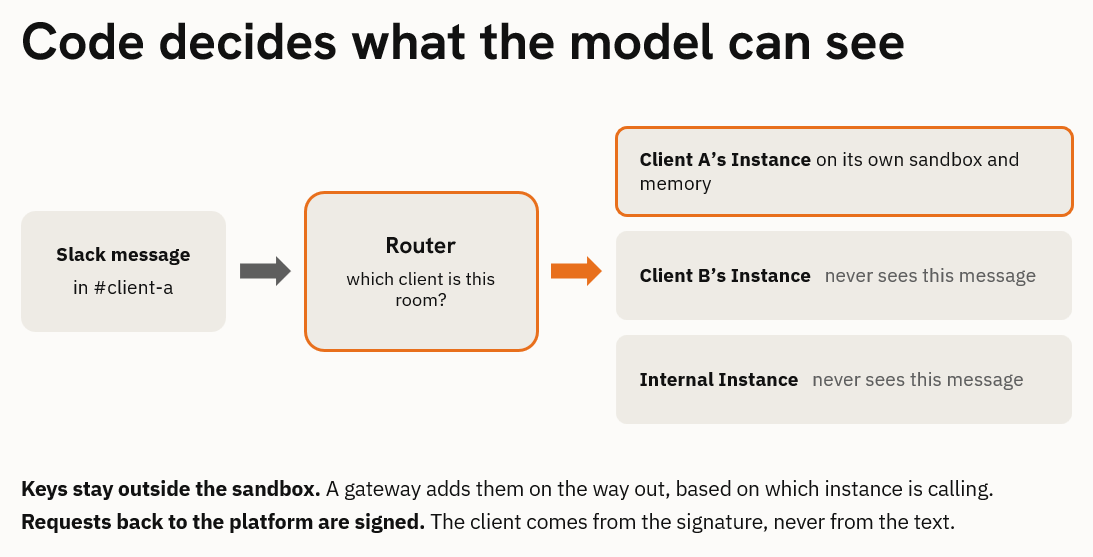
Our routing service decides in code which client a room belongs to. This is based on the identity of the sender of the message as well as the context within which the message was sent. Each client gets its own Worker instance with its own sandbox and memory. If we can't tell which client a message belongs to, or can't wake that client's sandbox, we drop it. It never falls back to an instance that can see everything.
One of the other ways that we protect our clients' data is by making sure that keys and tokens never enter the sandbox. If an LLM determines that a call to an external system is needed, it triggers a tool call, and a gateway service adds the key/token on the way out. Requests back to the platform are signed, and the client a request belongs to is read from the signature, never from the text.
Memory Comes in Layers (the Q&A question)
During the Q&A after the talk, someone asked about how we isolate and store memory. We store memory in 4 layers:
- Ergoly's platform defaults
- Organization-specific memory
- Worker-specific memory
- Client-specific memory (which may include Client-specific memory about a particular Worker)
If two layers of memory say different things, the narrower one wins. A client's instance of the Worker loads only its own client's layers.
We run a separate sandbox and memory for each Organization + Worker + Client combination. The internal instance has no client, so it loads every client's layers. That's how it knew the recipe existed. The base instructions are what kept the Worker from sharing it.
The proof that it works was in the demo: Testy saved the recipe to Secret Sauce's notes. Copycat's Worker instance can't load those notes at all. That's a guarantee, not trusting the inference to do the right thing.
Two Things You Can Use
First, take the scope from where a request came from, or from who signed it. Never from what the request says.
Second, give each client its own sandbox and memory so that Client A's data is never loaded where Client B's work runs.
Thanks, and Where To Go Next
Thanks to Dan Moore, co-founder and CTO of Ergoly, for starting the new AI Tinkerers track. Thanks also to AJ Gleser, co-founder and CEO of Ergoly, for his presentation "Who Answers? AI Teammates in a Shared Channel," where he demonstrated how we're using a fast model to decide which teammate, if any, responds in an environment or thread with multiple Workers.
We also had presentations from:
- Ryan Waliany (Ambiguous) showed a self-driving marketing agent built on Ambiguous Workspace that runs marketing tasks autonomously.
- Pejman Pour-Moezzi (Magoosh / Chickpea) demoed a platform for building AI teammates and focused his talk on the "AI Teammate Cold Start Problem," or how to get these agents quickly ramped up on the team's day-to-day work.
- Justine Sakowicz (Compound Loop) presented on her multi-agent system, built with Claude Code and Cowork, that automates Meta performance marketing for one of her clients. Human approval gates keep a person in the loop at each handoff.
You can find the full recap here: https://seattle.aitinkerers.org/meetup/mu_xUouy8spzgo/recap
Talk details, and eventually the video, here: https://seattle.aitinkerers.org/talks/rsvp_NDI9pneoaHs