
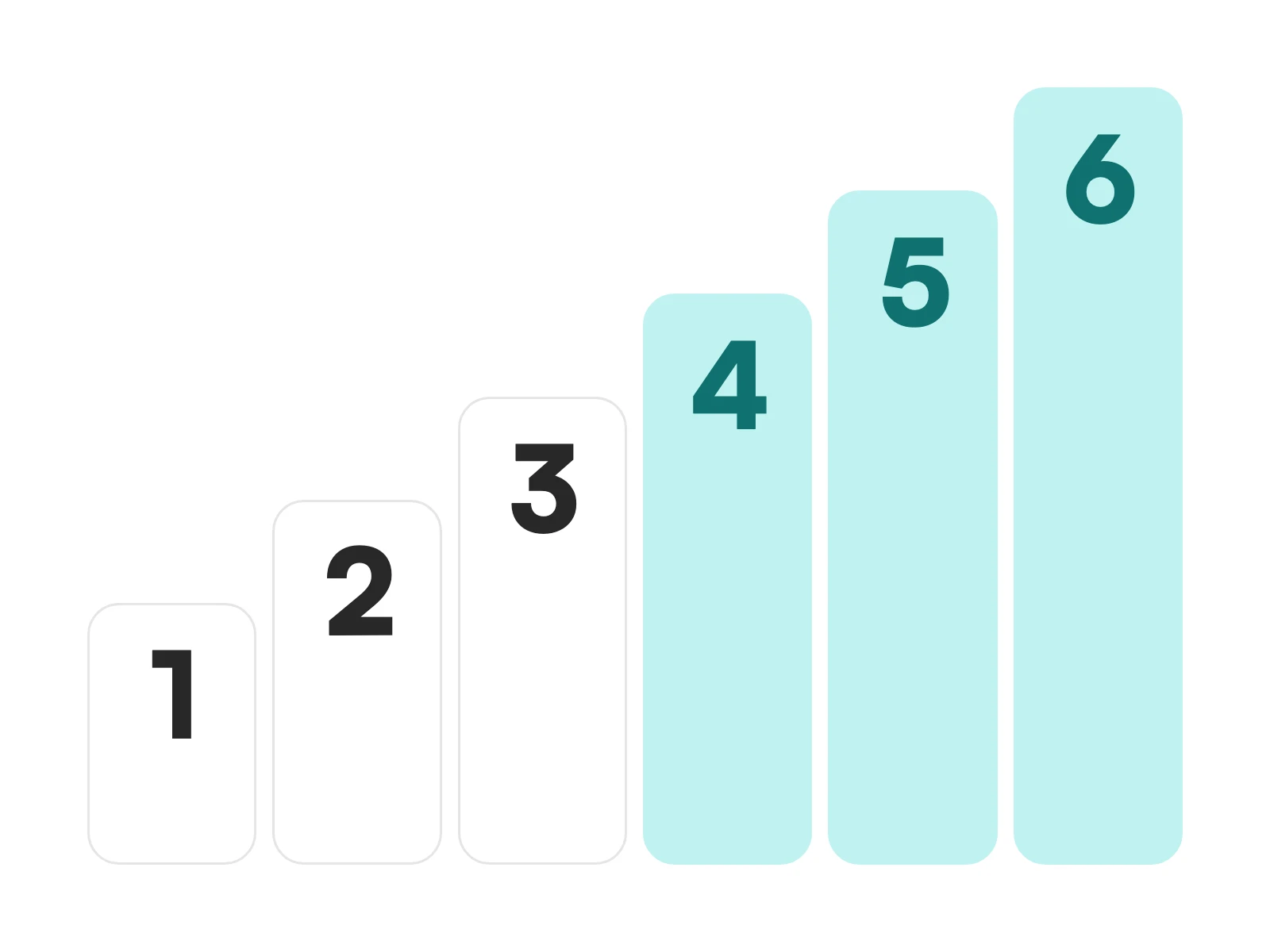
The six levels
What is an AI teammate? sorted AI at work into tools, agents, assistants and teammates. This note is about the company: how far each of those reaches into it.
Level 1
Individuals use AI tools
People bring a chat window to their own work. Nothing about the company changes. This is where most companies are today.
Level 2
Processes run on AI agents
Someone picks a process, defines the task, and connects an agent to an event. The work happens without a person watching.
Level 3
People have AI assistants
Each person gets an assistant that takes whatever they hand it. Individuals get faster. The team’s work is organised the way it was.
Level 4
AI teammates join teams
An AI takes a role on a team, with a manager and responsibilities of its own. This is where Ergoly starts.
Level 5
AI teammates run teams
Teammates manage other teammates. A person sets the direction, and the work underneath is theirs.
Level 6
AI teammates serve customers
Teammates work with the company’s customers: placed on a client’s team by a firm that sells its expertise, or shipped with a product to onboard, support and run the account.
The levels describe reach, not a required order. A firm can put a teammate in front of clients before it has teammates running teams, and firms that sell their expertise often start there.
Adoption should get easier, not harder
Levels 1 to 3 are digital transformation as we have always known it. The technology arrives and the company bends around it. People are trained to prompt. Processes are mapped, redrawn and handed to an agent. Everyone is asked to change their habits to make room for an assistant.
Each of those needs a change programme, and change programmes are slow.
Level 4 runs the other way. A teammate is brought in the way a person is. You write the role, name a manager, add it to the channels where the team already works, and give it feedback when it gets something wrong. Every company already knows how to do those things.
The org chart is the integration.
This is Dan Moore’s law at work: what we build for AI ends up mirroring what society already built for people. Roles, managers, onboarding and reviews are that machinery, and every company has it installed.
So the claim is this. The further up these levels a company goes, the less it should have to change for the technology, and the more the technology should fit the way the company already works.
What we haven’t answered
A person comes with settled answers to questions a teammate does not have yet.
- Cost
- What should a role cost, who sets the budget, and how does a manager see it before it is spent?
- Speed
- When should a teammate be fast and when should it be thorough, and who decides: the teammate, its manager, or the work itself?
- Cadence
- Should it work continuously, on a daily rhythm, or when asked? How often should it report, and to whom?
- Approval
- Which decisions does it make alone, and which wait for a person?
- Scope
- Is each of these set once for the company, per team, per role, or per piece of work?
Our view is that every one of these should be adjustable everywhere work happens, the way it already is for people: a company policy, a team norm, a manager’s call.
We don’t have all the answers. We are building toward them, and we would like to hear yours.
Last updated November 17, 2026
All feedback and criticism is welcome.