
 ChatGPT
 Claude
 Agentforce
 Copilot Studio
 Muse
 Grok Team Bots
 Ergoly
 You
One word, four things
In March 2025 I wrote the Agent Maturity Model to argue that an LLM that calls tools is not an agent. The word spread anyway. Today a chat window, a scheduled job, a personal assistant and a colleague in your Slack are all sold as “agents”.
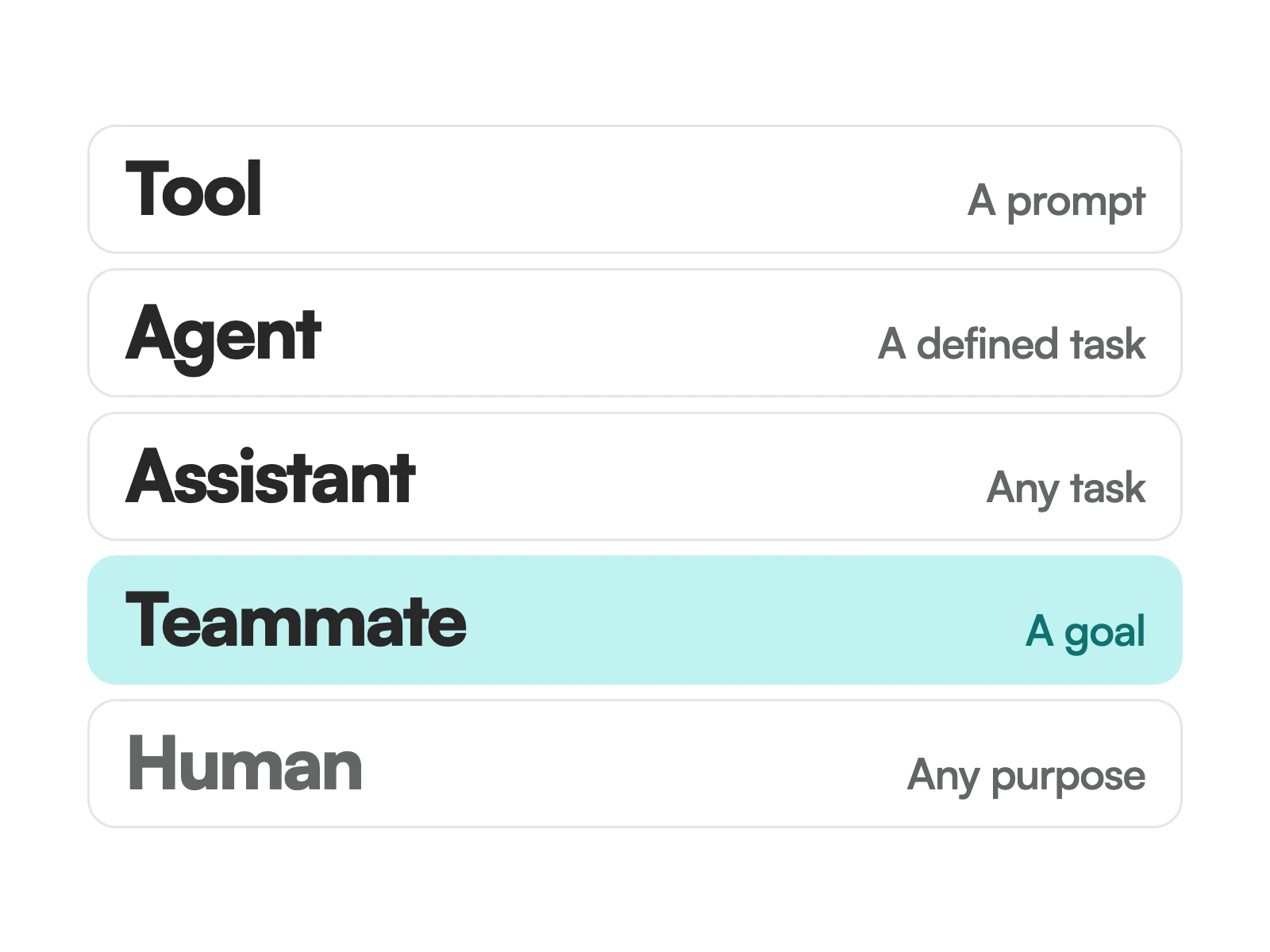
When one word covers four things, nobody can say what they are buying, building or managing. So we stopped trying to fix the word and split it into four. Then we added a fifth column for people, because that is who a teammate gets compared to.
Each column answers the same four questions: who it is for, what it takes, what it does, and what it returns.
Tool
- For
- Any user
- Takes
- A prompt
- Does
- Works as directed
- Returns
- A response
A tool works while someone is driving it. ChatGPT answering a question and Claude working through a long piece of code are both tools: very capable, and still operated. When you stop, it stops.
That is the first thing the table is for. Capability is not what moves something to the right. Who it is for does.
Agent
- For
- An event
- Takes
- A defined task
- Does
- Completes a task
- Returns
- A scoped result
An agent is built ahead of time for one task, and something other than a person sets it off: a ticket arrives, a form is submitted, a schedule fires. Nobody is watching when it runs.
Agentforce and Copilot Studio are where most companies meet this. The task and the result are both fixed by whoever built it, which is what makes an agent dependable and what makes it narrow.
Assistant
- For
- One person
- Takes
- Any task
- Does
- Completes a task
- Returns
- Any result
An assistant does the same kind of work as an agent: a task, then the next one. The difference is breadth and belonging. It takes whatever its person hands it, and it is that person’s.
Muse and Dots are built this way, a personal agent for each person. However much an assistant can do, its work is its person’s work. If that person leaves, there is nothing left for it to do.
Teammate
- For
- A team
- Takes
- A goal
- Does
- Performs responsibilities
- Returns
- Outcomes
This is the first column where the input is not a task. A goal is an outcome to reach, not a list of steps. Nobody lists the tasks: the teammate works out what the goal needs today and does it.
It is for a team, not for one person, so it is still there when any one person leaves. It has a manager and a place on the org chart, and it can be coached.
A name and an avatar do not make a teammate. Plenty of agents have been given both. What makes one is that it holds the role, builds its own memory and skills as it works, and is the same colleague to everyone on the team.
Grok Team Bots is the best-known attempt at this. Ergoly is ours.
Human
- For
- Self
- Takes
- Any purpose
- Does
- What matters
- Returns
- Accountability
People are in the table because the comparison is going to be made anyway, and it should be made honestly.
A teammate is given its role. A person chose theirs and can leave it. A teammate can own the work. A person answers for it. And somebody still has to decide what the team is for.
That column is not being automated. It is the reason the other four exist.
Why a new word
We could have kept saying “agent” and added adjectives: autonomous, long-running, role-based. The trouble is that the difference is not one of degree.
A better agent is still handed tasks. An assistant with more access is still one person’s. You do not reach a teammate by improving either. You reach it by changing what it is given, a goal in place of a task, and who it is for, a team in place of a person.
A different thing deserves a different word. “Teammate” is the one people already use for someone who holds a role beside them.
Products move between columns
These are kinds of work, not brands. The same product can sit in two columns depending on how it is run: a coding tool you drive in a session is a tool, and the same tool running overnight on a schedule is an agent.
Several of the products named here are moving to the right as fast as they can. Read the examples as a guide to the column, not as a verdict on the company.
Next: Six levels of AI at work, on how far each of these reaches into a company, and why adopting a teammate should be easier than what came before.
Last updated November 17, 2026
All feedback and criticism is welcome.